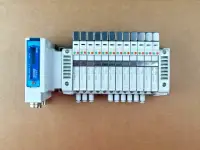


What a valve terminal is
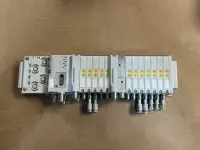
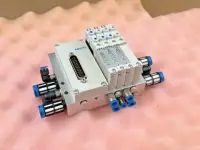
On an older machine each cylinder has its own solenoid valve, each valve its own cable back to the PLC output card. A valve terminal (valve manifold, valve island) mounts the valves side by side on one base with a common air supply and common exhausts. The electrical side is either one multi-pin plug carrying all the coils, or a fieldbus node, in which case one bus cable and one 24 V supply replace dozens of wires.
CPX, VTUG and MPA: which is which
The Festo names describe different layers, and a single installation can carry several of them.
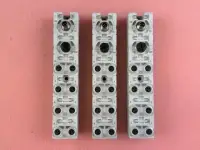
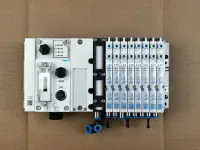
- CPX is Festo's modular electrical terminal: a row of electronic modules on interlinking blocks. At one end sits the bus node, which decides the fieldbus. Input and output modules sit beside it, and a valve manifold can be bolted on as well.
- MPA is a valve manifold that often sits on a CPX terminal. Its parts carry codes beginning VMPA.
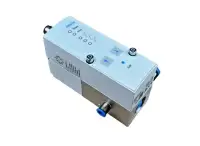
- VTUG is a compact valve manifold available with a multi-pin plug, individual connection, fieldbus, I-Port or IO-Link. Festo builds it in 10, 14 and 18 mm valve sizes, with up to 24 valve positions and 24 V DC coils.
Our CPX-FB38 is an EtherCAT bus node, delivered with its CPX-GE-EV-S-7/8-5POL interlinking block and the VMPA parts listed on its page. Festo lists the FB38 as being discontinued. The newer CPX-FB37, also EtherCAT, has a compatibility mode for the FB38, which helps when only the node has failed. Our two VTUG units are on the VTUG part page.
Reading a Festo part number and type code
Every Festo product has two identifiers on its label, and you need both.
- The part number is a plain number of six or seven digits, such as 560204. It identifies one catalogue product.
- The type code is the readable name built from fields separated by dashes, such as HGPT-25-A-B. Each field is a feature.
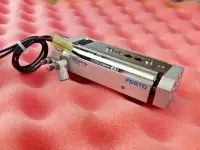
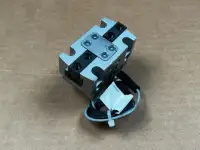
Our HGPT-25-A-B, part number 560204, decodes like this against Festo's data sheet:
| Field | Meaning |
|---|---|
| HGPT | Parallel gripper, HGPT series |
| 25 | Size 25 |
| A | Position sensing via proximity switch |
The data sheet adds the rest: 6 mm stroke per jaw, double-acting, 3 to 8 bar operating pressure, M5 air ports, 266 g. We have left the B field to the data sheet.
Valve terminals work differently. 573606 is the part number of the VTUG product as a whole; the long type code that follows it, such as VTUG-10-MSDR-B1TZ-25V22-G18-U-M5S-GLTPPL on ours, describes one exact build, from the valve size (10 mm on ours) to the electrical connection and the valves fitted. Two VTUG terminals with the same 573606 can be quite different, so always quote the full type code. Festo's VTUG catalogue explains each field.
5/2 vs 5/3 valves
The two numbers are ports and positions. A 5/2 valve has five ports (supply, two outlets, two exhausts) and two switching positions. A 5/3 valve has a third, middle position that it takes when neither coil is energised.
| Valve | Unpowered behaviour | Typical use |
|---|---|---|
| 5/2 monostable | A spring or air spring returns it to its home position | Most cylinders: the cylinder retracts when the signal goes |
| 5/2 bistable | Two coils, stays in the last position | Holds position after a short pulse, also through a power cut |
| 5/3 closed centre | All ports blocked | Holds the cylinder where it is, as long as nothing leaks |
| 5/3 exhausted centre | Both cylinder ports vented | Cylinder can be pushed by hand |
| 5/3 pressurised centre | Both cylinder ports pressurised | Less common; follow the machine's documentation |
VTUG also offers 3/2 valves and double 3/2 valves (two 3/2 valves in one position), which drive single-acting cylinders, vacuum generators or blow-off nozzles.
What a machine does when the air or the power goes depends on these choices, and the machine's risk assessment depends on them too. When you replace a terminal, put the same valve function in each position, and depressurise and lock out the machine first, following its own procedure.
Single-acting vs double-acting cylinders
A single-acting cylinder has one air port. Air pushes the piston out and a spring brings it back, so a 3/2 valve is enough. The stroke is short and the spring takes away some of the force.
A double-acting cylinder has two ports, one on each side of the piston. Air drives it both ways, so it needs a 5/2 or 5/3 valve. Most machine cylinders are double-acting, and so is the HGPT gripper above. Before ordering a replacement, count the air ports on the old one: a single port means single-acting.
Aventics and SMC valve terminals
The same ideas apply to other makers, but the parts do not cross over. The Aventics AES-D-BC-ECAT (R412018225) is an EtherCAT bus coupler for the AES system; it connects only to Aventics AES I/O modules and Aventics valve drivers. The SMC EX260-SPR1 is a PROFIBUS DP node for 32 outputs with an M12 bus connector; its station address is set on switches (1 to 125) and it has its own termination switch for the end of the line. Its page lists the valves that came with it. How to tell the buses apart is in our fieldbus guide.
Asking for a price
Read both numbers off the label, the part number and the full type code, and send them to us. We will check the match against what is on our shelf in Szeged, describe the condition in the quote and ship by FedEx. Ask for a price here.