Fixed-mount or handheld
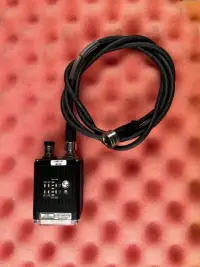
A handheld scanner is for a person: a worker in goods-in or at a packing bench. A fixed-mount reader is for a machine. It sits at a fixed distance from the code, takes its trigger from a photoelectric sensor or the PLC, and sends the result, or a no-read, to the controller. Fixed readers are usually IP65, run on 24 V DC (with exceptions, below) and have discrete outputs for good-read and no-read.
Everything on this page is about fixed-mount readers, which is what we stock.
1D, 2D and DPM codes
- 1D barcodes (Code 128, EAN, Code 39) are read along one line. A laser line scanner such as the SICK CLV432, with its oscillating mirror, handles them well over a wide area.
- 2D codes (DataMatrix, QR, PDF417) need an image-based reader, a small camera with its own lighting. Nearly all current readers are image-based and read 1D as well.
- DPM codes (direct part marking) are dot-peened or laser-etched straight into metal or plastic. Low contrast and reflections make them the hardest case, and readers sell a separate model tier or licence for them.
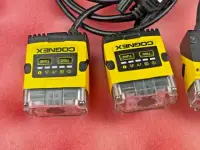
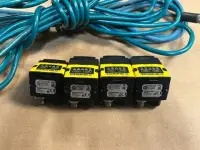
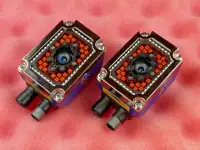
Cognex DataMan
The DataMan 150/260 family shares one housing and one optics range. Per Cognex's datasheet, the 150 and 152 talk RS-232 and USB, and the 260 and 262 talk RS-232 and Ethernet, with power from 24 V or Power over Ethernet. The 152 and 262 have the higher-resolution sensor (1280 x 960 against 752 x 480).
The letter after the number is the capability tier:
| Tier | What Cognex says it reads |
|---|---|
| QL | 1D barcodes only, omnidirectional. Field-upgradeable to Q |
| S | Well-marked 1D and 2D codes on slow-moving or indexed parts |
| Q | 1D and 2D codes on fast-moving parts |
| X | Challenging 1D and 2D codes, including DPM |
So a DM260Q is an Ethernet reader for 1D and 2D codes on a fast line, and a DM150S is a serial/USB reader for slower parts. The smaller DataMan 50 series, such as our DM50S, offers RS-232 and USB.
DataMan 260 readers use an X-coded M12 Ethernet cable (Cognex CCB-84901-2001-xx, the xx being the length) and a 12-pin M12 power and I/O cable (CCB-PWRIO-xx). We have the Ethernet cable in 10 m and the power and I/O cable in 15 m.
Keyence SR
| Model | Type | Interface | Supply |
|---|---|---|---|
| SR-700, SR-710 | Ultra-compact, 1D and 2D. SR-710 is the middle-range type, about 45 to 195 mm for barcodes | RS-232C, USB; N-R2 unit for RS-232C, N-L20 for Ethernet | 5 V DC |
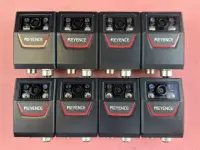
| SR-751 | Compact 2D code reader, medium-distance type, 180 to 330 mm | Ethernet (EtherNet/IP, PROFINET, TCP/IP) and RS-232C | 24 V DC or PoE |
| SR-1000, SR-1000W | Autofocus 1D and 2D; W is the wide-field type, 50 to 600 mm | Ethernet (EtherNet/IP, PROFINET), RS-232C, USB | 24 V DC |
| SR-2000W | Autofocus, ultra-wide field, 50 to 1000 mm, 2048 x 1536 sensor | Ethernet (EtherNet/IP), RS-232C, USB | 24 V DC |
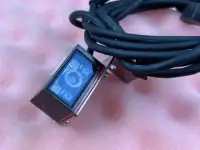
The one to watch is the SR-700 family's 5 V supply. It normally runs through a Keyence communication unit such as the N-R2, which we also hold. Check the supply before you connect an SR-710 anywhere near a 24 V machine supply.
The Keyence families and their model numbers are covered in our Keyence sensors guide.
Datalogic, SICK and Wenglor
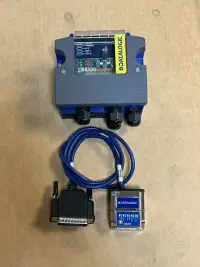
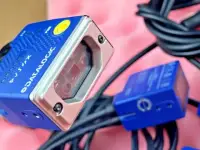
- Datalogic Matrix 210 (our 210-212-101 units are listed with a CBX100 connection box, used to wire up power, serial lines and I/O), the Matrix 120 and the Matrix 300N.
- SICK CLV432-6010: a short-range laser line scanner with an RS-232 or RS-422/485 host port and a CAN interface.
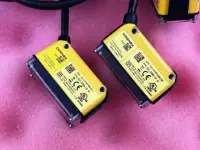
- Wenglor FIS-6801-1511G-01: a Wenglor barcode reader.
Interfaces: what talks to your PLC
- Ethernet with an industrial protocol (EtherNet/IP, PROFINET): the reader appears in the PLC project like any I/O device, and the decoded string lands in a data block. Load the maker's device description file (EDS or GSD) into the PLC tool.
- TCP/IP socket: simplest for a PC or MES that just wants the string.
- RS-232 / RS-422/485: still common on older lines, and on readers like the DataMan 150 or SR-710. Agree baud rate and framing on both ends.
- Discrete I/O: a trigger input and good-read/no-read outputs, wired like any PNP sensor.
What to check when buying a used reader
- The exact model, tier included. A DM260QL will not read 2D codes; an X model reads DPM where a Q may not. The tier is on the label.
- Distance and field of view. Measure your code size and the mounting distance, then compare with the reading range in the datasheet. Lens and lighting options vary within a family.
- Supply voltage. 24 V for most, 5 V for the Keyence SR-700 family, PoE as an option on the DataMan 260 and SR-751.
- Cables. M12 X-coded Ethernet and 12-pin power/I/O leads are expensive new. Ask for them with the reader.
- The window. A scratched front window costs read rate. Ask for a photo of it.
- Settings. A used reader carries the last machine's configuration. Plan a reset to factory defaults with the maker's setup software before commissioning.
We describe the condition of each reader in the quote, and photos are available on request.
On our shelf
In Szeged we hold Cognex DataMan readers (DM50S, DM150S, DM260Q, eight DM262B) with their cables, eight Keyence SR-751 and sixteen more SR readers, Datalogic Matrix readers, a SICK CLV432 and a Wenglor FIS-6801. Send the model you are replacing, or your code and distance, through the price request form, and we will suggest what fits.