

Two ways to measure force
A piezoelectric force sensor contains crystals that give off an electric charge when they are squeezed. Kistler is the best-known maker of this type. The charge is tiny, measured in picocoulombs, and it needs a charge amplifier to become a usable voltage.
A strain-gauge load cell is a metal body with strain gauges bonded to it in a Wheatstone bridge. The body bends very slightly under load, the bridge goes out of balance, and the output is a few millivolts. An amplifier powers the bridge and scales that signal up. Almost every weighing cell in industry works this way, and so do many press sensors from makers such as burster.
| Piezoelectric | Strain gauge | |
|---|---|---|
| Output | Electric charge (pC) | Millivolts from a bridge |
| Electronics | Charge amplifier | Bridge amplifier with excitation voltage |
| Holding a constant load | Drifts slowly, so measures quasi-statically | Stable for hours, suited to weighing |
| Stiffness | Very stiff (Kistler gives about 1.5 kN/µm for the 9313AA2) | The body deflects slightly by design |
| Typical job | Press-fit, riveting, crimping, fast events | Weighing, static loads, slower presses |
Why a piezo sensor drifts
The charge from a piezo crystal has to be held by the amplifier and the cable. Nothing in that circuit has infinite insulation resistance, so the charge slowly leaks and the reading creeps. Kistler explains it on its own quasi-static vs dynamic measurement page: the higher the insulation resistance in the system, the smaller the drift, and because a little drift always remains, the measurement is called quasi-static.
For a press-fit that lasts a second or two, this does not matter. The amplifier is normally zeroed at the start of each stroke, the force curve is recorded, and the drift over that time is negligible. For a scale that has to hold a weight reading all shift, it does matter, and that is why weighing uses strain gauges.
Two practical consequences when you replace parts:
- Use proper low-noise, high-insulation cable between sensor and amplifier, and keep the connectors clean and dry. A damp or dirty connector lowers the insulation and makes the drift worse.
- A piezo sensor cannot be wired into a strain-gauge amplifier, or the other way round. The electronics must match the sensor type.
Kistler press force sensors on our shelf
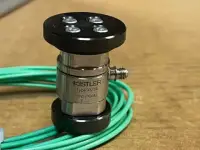
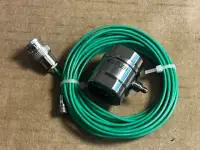
Kistler press force sensors are preloaded, single-axis piezo sensors made for joining stations. Kistler lists them by maximum range:
- 9313AA2: lightweight miniature press force sensor, 0 to 20 kN, about 25 g without cable.
- 9323A: press force sensor; the 9323A family runs up to 20 kN depending on variant and calibrated range.
- 9333A: press force sensor, 0 to 50 kN. We have three.
The range on the calibration sheet is what counts, so check the sheet that belongs to your sensor, and compare its sensitivity in pC/N with the value set in your amplifier or monitor. A replacement sensor needs its own sensitivity entered. We also hold a Kistler KiTorq 4551A torque rotor for 200 N·m (4551ANB), from the torque side of Kistler's range.
Press-fit monitoring: maXYmos and Promess
Measuring the peak force is not enough to judge a press-fit. A bearing pressed into a bore produces a force curve over distance, and a good part has a recognisable shape. Process monitors record force against displacement as an XY curve and check it against limits.
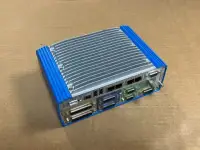
Kistler's maXYmos is the best-known of these. Kistler describes the maXYmos TL (type 5877B) as building on the maXYmos BL (type 5867B) with more evaluation options: it can be cascaded to 8 XY channels and checks up to 10 evaluation objects per curve. Press-fitting of bearings and valve seat rings are among the uses Kistler names. On our shelf are two maXYmos TL 5877B units, a 5877AZ000 display and a 5867B0011 from the BL range.
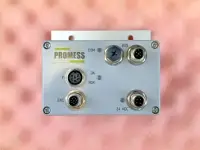
Promess builds electromechanical servo presses (the UFM series) with the force and displacement measurement inside the press. On its UFM Line5 the force-displacement sensor is integrated, and Promess fits strain-gauge or piezo force measurement depending on the customer. We hold a UFM Line5 unit listed at 10 kN, a 14650 load cell amplifier module and a DUM6 servo motor.
Strain-gauge amplifiers: burster 9235
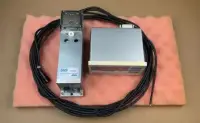
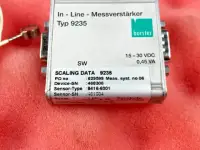
The burster 9235 is an in-line amplifier for full-bridge strain-gauge sensors. From burster's datasheet: bridge resistance 350 ohm to 5 kohm, 2.5 V bridge excitation, output 0 to ±10 V, supply 15 to 30 V DC, frequency response 1 kHz. It is roughly set by DIP switches through an opening in the housing. We have 11 of them, plus 6 burster 200 N load cells with 9235 amplifiers. Follow the pin assignment in burster's datasheet for your version when wiring.
Weighing cells: A&D AD-4212C with AD-8923-CC
A&D's AD-4212C is a compact weighing sensor built on what A&D calls its Super Hybrid Sensor (SHS). The AD-8923-CC is its remote controller: it shows the weight, sets weighing speed, runs calibration and sends the result to a PLC over CC-Link, talking to the sensor over RS-232C. The two can share one power supply. We have 24 AD-8923 controller and AD4212C-6000 weighing cell kits, enough to refit a whole line of weighing stations.
A note on search terms: a pressure sensor measures the pressure of air, oil or water. A press sensor or load cell measures force. They are different devices, and our sensors category holds both.
Matching a replacement
- Read the type code and serial number off the sensor, and find the calibration sheet that goes with that serial number.
- Check that the amplifier or monitor matches the sensor technology: charge input for piezo, bridge input for strain gauge.
- Enter the replacement's own sensitivity and re-check the curve limits with a reference part before production.
If one of these is the part your line needs, send us the type code from the label through the price request. We quote the price, the condition of the piece on our shelf in Szeged and the FedEx cost to you; photos on request.