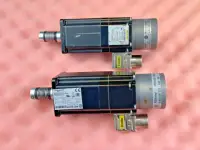

Open loop and closed loop
A stepper motor turns a fixed angle for every pulse the drive sends. A common hybrid stepper has 200 full steps per revolution, so 1.8 degrees per step, and the drive can split each step further (microstepping). The controller counts pulses and assumes the shaft followed. Nothing checks it. That is open loop.
A servo motor has a feedback device on the shaft: a resolver, an incremental encoder or an absolute encoder. The servo drive compares the commanded position with the measured one thousands of times a second and changes the current to close the gap. That is closed loop. When a load pushes back, the drive pushes harder, up to the motor's peak current.
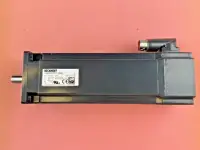
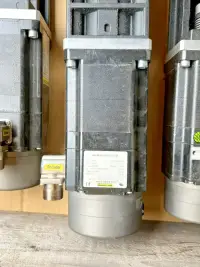
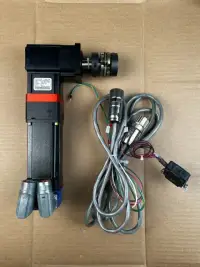
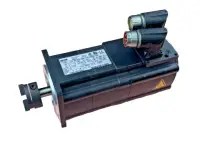
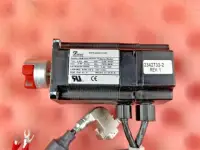
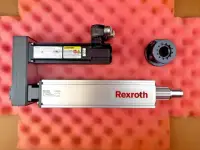
Most industrial servo motors you meet today are permanent magnet synchronous motors with three phases: the Rexroth MSK, Beckhoff AM8000, Kollmorgen AKM and Goldline, Pacific Scientific PMB and Lenze MCS ranges are all of this type. Steppers in machines are mostly two-phase hybrids, with three-phase and five-phase types from makers such as Berger Lahr (now Schneider Electric).
Losing steps
When a stepper is asked for more torque than it has, it stalls or slips a step, and the controller never finds out. The axis is now off by that amount until it is homed again. On a label feeder that may be a wrong label. On a press or a gantry it can be a crash.
Steppers also have resonance zones where they run rough or stall at low and medium speeds, and they pull full current at standstill, so they run warm even when doing nothing. A servo draws current in proportion to the load and holds position actively.
Closed-loop steppers exist: a stepper motor with an encoder and a drive that notices and corrects lost steps. They sit between the two and are worth a look for small axes.
Torque at speed
This is where the two differ most on the datasheet.
A stepper gives its highest torque at standstill (holding torque) and loses it quickly as speed rises, because the winding inductance stops the current from building up in each short step. Above roughly 1,000 rpm a typical stepper has little left.
A servo motor keeps close to its rated torque up to its rated speed, often 3,000 rpm or more, and can deliver a peak of several times its continuous torque for short accelerations. It is also smaller for the same work.
| Stepper motor | Servo motor | |
|---|---|---|
| Control | Open loop, pulse counting | Closed loop, feedback on the shaft |
| Torque | Highest at standstill, falls with speed | Close to rated torque up to rated speed |
| Overload | Stalls or loses steps, unnoticed | Drive raises current, then trips with an error |
| Speed range | Best below about 1,000 rpm | Typically up to 3,000 to 6,000 rpm |
| Standstill | Full current, motor runs warm | Current only as the load needs |
| Cost | Motor and drive low | Motor, cable and drive several times higher |
| Commissioning | Wire it and send pulses | Tuning, motor data, encoder setup |
Cost and setup
A stepper motor, its drive and a plain four-wire cable cost a fraction of a servo package. The drive needs step and direction signals or a simple fieldbus, and there is nothing to tune.
A servo package means the motor, a matching drive, a power cable and an encoder cable, and the motor, encoder and drive must agree. A Rexroth MSK motor runs on a Rexroth IndraDrive with Rexroth cables (we have RKL4302 power and RKG4200 encoder cables on the shelf); a Beckhoff AM8000 motor uses Beckhoff's one-cable technology with an AX5000 or AX8000 drive. Mixing makers is possible but only when the drive can read the motor's encoder type. More on this in frequency inverters and servo drives.
When a stepper is enough
- Light loads that do not change much: format adjustment, valve positioning, small feeders, dosing pumps.
- Low speeds, short moves, where an occasional re-homing is acceptable.
- Axes that spend a long time at standstill holding position against a small load.
- Projects where cost and simple wiring matter more than speed.
The Jenaer ECOSTEP drives and the Jenaer 34S stepper motor on our shelf are a typical pairing for this kind of axis.
When you need a servo
- High speed or high dynamics: pick and place, flying saw, cut to length, packaging machines.
- Loads that change, or that must never be lost: vertical axes, presses, gantries.
- When the machine must know where it is at power-up: a servo with a multiturn absolute encoder keeps its position without a homing run.
- Synchronised axes on EtherCAT, SERCOS or PROFINET, where the drive does the position loop.
Servo axes often carry a planetary gearbox to match the load to the motor; see planetary gearboxes on servo motors.
Reading the nameplate
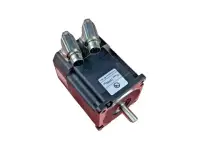
Online listings, ours included, sometimes call any motor that comes with a drive a servo. The nameplate settles it. A stepper plate gives the step angle (1.8 or 0.72 degrees, for example) and current per phase. A servo plate gives continuous and peak torque, rated speed, a voltage constant in volts per 1,000 rpm, and an encoder or resolver code. The Schneider BRS368W131FCA on our shelf came to us described as a servo motor. It is a Lexium BRS3 three-phase stepper with a holding brake, the range that grew out of Berger Lahr.
If you want to check a used servo before fitting it, our guide on testing a servo motor and its encoder walks through it.
On our shelf in Szeged
Servo motors from Rexroth, Beckhoff, Kollmorgen, Pacific Scientific, Lenze and Maxon, and stepper motors and drives from Jenaer and Berger Lahr. Everything is in the servo drives and motors category. If one of them fits your axis, send us the part number from the price request form and we will tell you the condition of the actual piece and the FedEx cost to you.