

What sits on the 24 V rail
PLC CPUs and I/O, sensors, valve coils, relay coils, HMIs, safety relays and fieldbus couplers all run on 24 V DC. A DIN-rail supply turns the mains (single-phase 230 V AC or three-phase 400 V AC) into a regulated 24 V. Wiring the mains side is work for a qualified electrician; everything below assumes the input side is done properly and protected.
Industrial supplies are switch-mode: they rectify the mains, chop it at tens of kilohertz through a small transformer, and regulate the output. That is why a 20 A supply fits in a hand rather than weighing as much as a car battery.
How to size a 24 V power supply
Start with the continuous load, then add for switch-on and for later.
- Add up the continuous currents from the datasheets: CPU, I/O modules, sensors, the valve and relay coils that can be on at the same time. Say it comes to 12 A.
- Allow for inrush. Capacitive inputs on drives and HMIs, lamp loads and big coils all draw a peak at switch-on. A supply with a boost reserve rides through it; a supply that is already at its limit may fold back and restart in a loop.
- Add reserve. 20 to 30 percent keeps the supply cooler and leaves room for the module someone adds next year. 12 A plus a quarter is 15 A, so you would fit a 20 A unit.
- Check derating. Output current is quoted up to a certain ambient temperature, often 60 °C, and falls above it. Mounting position and spacing to neighbours matter too; the datasheet has the curve.
Single-phase or three-phase input?
Single-phase (1AC) supplies cover most cabinets, and QUINT makes them up to 40 A. From about 20 A upward three-phase (3AC) units are common: they connect to three phases without a neutral, load the phases evenly and keep the input current per phase low.
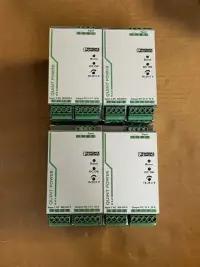
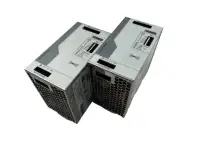
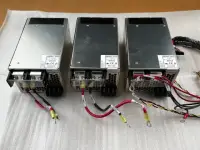
Our shelf holds both sizes of three-phase QUINT: QUINT4-PS/3AC/24DC/20 (480 W), the older QUINT-PS/3AC/24DC/20 and the 40 A QUINT-PS/3AC/24DC/40, six of those.
Phoenix Contact QUINT POWER
QUINT is Phoenix Contact's top range of DIN-rail supplies, and the reason it is in so many cabinets is what it does when something goes wrong downstream.
- SFB technology (Selective Fuse Breaking). For a few milliseconds the supply delivers a multiple of its rated current, so a short circuit trips the ordinary circuit breaker on the faulty branch while the others keep their voltage. The QUINT4-PS/3AC/24DC/20 delivers 120 A for 15 ms.
- Boost. Above rated current for longer. The same QUINT4 gives 30 A dynamic boost for up to 5 s, enough to start a load with a heavy inrush.
- DC OK signal. A switching output (and on many models a relay contact) that reports whether the output voltage is in range. Wire it to a PLC input and the PLC knows the supply is struggling before the I/O starts dropping out.
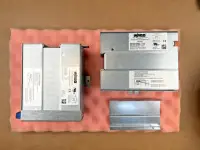
Other makers have their own versions of these features. TDK-Lambda, Siemens SITOP, WAGO Epsitron and Mean Well (its DIN-rail ranges include the SDR, NDR and HDR series) all make 24 V rail supplies. Not every 24 V supply in a cabinet is a rail type: the TDK-Lambda HWS600-24 (24 V, 27 A, 600 W) is a chassis-mount unit.
Protecting the 24 V branches
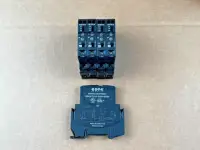
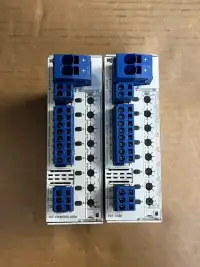
A 24 V supply limits its own current, so a standard miniature circuit breaker on the output may never see enough current to trip. There are two answers: a supply with an SFB-type reserve, or electronic circuit breakers on each branch. The E-T-A ESX10-TD is 12.5 mm wide and switches off one faulty 24 V circuit while the rest stay up; we have 62. WAGO's 787-1668 does the same for eight channels in one housing, and the Siemens SITOP PSE200U is a four-channel selectivity module.
Parallel and redundant operation
Two supplies on one 24 V bus can serve two purposes.
More power. Two identical units in parallel share the load. The manufacturer's manual says whether a model may be paralleled and how the output voltages have to be set.
Redundancy. Here each supply alone can carry the whole load (n+1). A redundancy module sits between the supplies and the bus. It decouples them with diodes or MOSFETs, so a failed supply with a shorted output cannot pull the bus down. Phoenix Contact's are the QUINT ORING modules. For real redundancy, feed each supply from its own breaker, and monitor both DC OK signals; otherwise a dead unit goes unnoticed until the second one fails.
| Parallel for power | Redundant (n+1) | |
|---|---|---|
| Each supply carries | Part of the load | The whole load |
| Redundancy module | Usually not needed | Needed |
| A supply fails | The rest may be overloaded | The bus stays at 24 V |
Riding through a mains dip: DC UPS
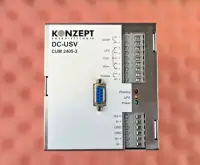
Where a PLC must not lose power during a short mains drop, a DC UPS sits after the supply. WAGO's Epsitron UPS uses a lead-acid battery module such as the 787-871 (we sell it without the battery) together with a charger/controller module. Battery-free versions use capacitors: the J. Schneider C-TEC 2410-10 stores 10 kJ in ultracapacitors for a 24 V, 10 A load, and the Konzept CUM 2405-3 covers 24 V, 5 A.
Asking for a price
Send us the part number from the label (for Phoenix Contact the seven-digit order number is the fastest, such as 2904622 for the QUINT4 20 A). We describe each unit's condition in the quote and ship from Szeged by FedEx. All supplies are listed under power supplies. Ask for a price.