

Read this first
This page explains how safety relays work so you can talk to your safety engineer, read a datasheet and find a replacement. It is not a safety design. A safety circuit is wired the way the device's operating manual shows for the safety function the machine's risk assessment calls for, by a qualified person, and it is function-tested afterwards. If the machine has a validation report, that report decides what you may fit.
What is a safety relay?
An ordinary relay closes a contact when its coil is energised. If a contact welds shut, nothing notices: the coil drops, the contact stays closed, and the motor keeps running.
A safety relay is built so that this kind of fault is found and the machine cannot restart until it is fixed. It does that with four things:
- Forced-guided contacts. The normally open and normally closed contacts are mechanically linked (EN 61810-3), so if one NO contact welds, the NC contacts cannot close. The relay reads its own NC contacts to see that.
- Redundancy. Two relays (or two channels in an electronic device) do the same job. One can fail and the other still switches off.
- Monitored reset. After a stop, the outputs come back only when someone presses and releases the reset button. A button that is jammed or bridged does not restart the machine.
- Feedback loop. The NC auxiliary contacts of the external contactors are wired back into the safety relay. If a contactor has welded, the relay sees it and refuses to reset.
Safety relay vs normal relay
| Ordinary relay | Safety relay | |
|---|---|---|
| Contacts | Free, can weld unnoticed | Forced-guided, monitored |
| Channels | One | Usually two, compared against each other |
| Restart after a stop | Whenever the coil is energised | Only after a valid reset |
| External contactors | Not checked | Checked through the feedback loop |
| Rated for | Switching current | A safety category and Performance Level (EN ISO 13849-1) |
Single-channel vs two-channel E-stop
A single-channel E-stop runs one NC contact of the E-stop button to the safety relay. One short circuit across the wires, or one welded contact in the button, and the stop no longer works. Single-channel wiring is used where the risk assessment says that is acceptable.
Two-channel wiring uses two separate NC contacts in the button, each to its own input. The relay checks that both open together. Many relays also detect a cross-short between the two channels; on the Pilz PNOZ X2.8P, for example, you choose two-channel with or without cross-short detection by how you wire it. Two-channel with cross-short detection is how the higher categories are usually reached, but the category comes from the whole circuit, button and contactors included, not from the relay alone.
Safety gates, door switches and light curtains
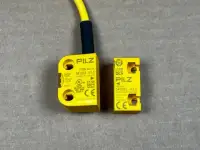
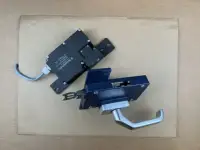
The same relay often watches a guard door. The door carries a safety switch or a coded magnetic sensor, such as the Pilz PSEN cs3.1 we have eleven of. Opening the door is treated like pressing the E-stop. Where the door must stay locked until the motion has stopped, an interlock with guard locking is used, such as the Schmersal AZM 161.
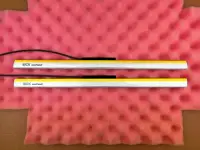
Light curtains have their own electronic outputs (OSSDs) that the relay reads. Check that the relay's datasheet lists light curtains of that type as a supported input. We have SICK miniTwin2 C2MT curtains with a 480 mm protective height.
The Pilz PNOZ families
Pilz makes the relays most people mean when they say "PNOZ". There are three families, and they replace each other only with care.
- PNOZ X is the classic range of fixed-function relays. The PNOZ X2.8P, the one most people search for, is 22.5 mm wide, runs on 24 V AC/DC, and has 3 NO safety contacts and 1 NC auxiliary contact, for E-stop and safety gate monitoring with automatic or manual reset.
- PNOZsigma is the newer compact range. The PNOZ s4 (order number 750104, 24 V DC, 3 NO and 1 NC) is the everyday E-stop and gate relay; the 751104 is the same relay as PNOZ s4 C with spring-loaded terminals. The PNOZ s7 C (751107) is a contact expansion, adding outputs to a base relay.
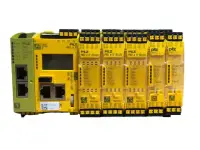
- PNOZmulti is a configurable safety controller. You draw the safety logic in Pilz's PNOZmulti Configurator software and download it to a base unit, then add input, output and fieldbus modules. On the shelf we have the PNOZmulti 2 base unit PNOZ m B1 (772101), the PNOZ m EF 8DI4DO (772142) and PNOZ m EF 4DI4DOR (772143) expansion modules, and the PNOZ m ES EtherCAT communication module (772136).
Pilz's own PSEN sensors and switches are the usual inputs: magnetic sensors like the PSEN cs3.1 and PSEN ma1.1p, and the PSEN door-lock set 570520.
Other makes we hold
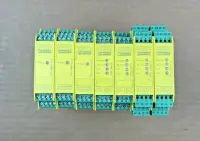
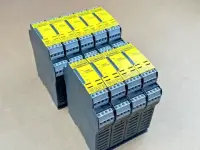
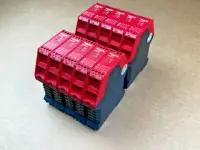
The Schmersal SRB 301MC has three safety contacts and one signalling output and also accepts light curtain outputs; we have nine. Schneider Electric's Preventa XPS-AC (XPSAC5121) runs on 24 V AC/DC with three NO safety outputs and one solid-state output. From Phoenix Contact we have the PSR range, including PSR-ESM4 relays and PSR-URM4 contact expansions. Euchner safety switches with guard locking (STP4A, TP4) round it off. Browse them all in safety parts.
What must match when you replace a safety relay
The safest replacement is the identical order number. If you have to change type, check each of these against the old relay's datasheet and the machine's documentation:
- The safety function and its rating. Category, PL or SIL the circuit was validated with. The new relay must reach at least that level in the same wiring.
- Supply voltage. 24 V DC, 24 V AC/DC or a mains-voltage version. A PNOZ X2.8P at 24 V AC/DC and a PNOZ s4 at 24 V DC are not interchangeable by supply alone.
- Inputs. Single or two-channel, with or without cross-short detection, light curtain capable or not.
- Reset mode. Automatic or monitored manual reset, and how the feedback loop is wired.
- Outputs. Number of safety contacts and auxiliary contacts, their current rating, and any delayed (stop category 1) contacts.
- Terminals and width. Screw or spring, plug-in or fixed, and whether it fits the space on the rail.
- For PNOZmulti: the configuration. The project file has to go onto the new unit, and the base unit must suit it. The PNOZ m B1 keeps its project on a USB stick, the PNOZ m B0 on a chip card.
After any change, a qualified person tests every stop function on the machine before it runs again.
Asking us for one
If you are looking for a Pilz, Schmersal or Phoenix safety relay, send us the full order number from the label, for example 750104 rather than "PNOZ s4". We describe the condition of each piece in the quote, ship from Szeged by FedEx and invoice. Ask for a price.