What a Carel pCO controller is
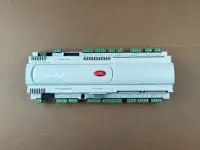
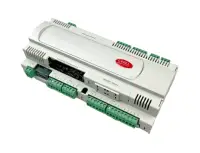
Carel calls the range the pCO sistema: programmable controllers built for HVAC and refrigeration. You find them in chillers, heat pumps, close-control air conditioners for server rooms, rooftop units, air handlers and steam humidifiers. Carel sells the hardware. The machine maker writes the program that turns a pCO board into a chiller controller or a humidifier controller, using Carel's development tool (1Tool for the pCO families covered here).
That is the one thing to understand before ordering a replacement. Two identical pCO2 boards can run completely different machines.
The pCO families
| Family | Where you meet it | Notes |
|---|---|---|
| pCO1 | Older and smaller units | Codes start PCO1 |
| pCO2 | Very common in chillers and air handlers from the 2000s | Small, Medium and Large board sizes |
| pCO3 | The generation after pCO2 | Codes start PCO3 |
| pCOXS | Compact units, humidifiers | Smallest board |
| pCO5, pCO5+ | Current generation of the pCO sistema | Optional built-in display |
| c.pCO | Carel's newer platform | Programmed with c.suite, not 1Tool |
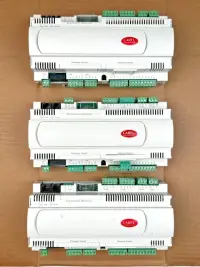
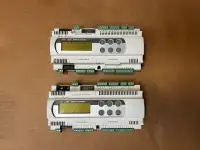
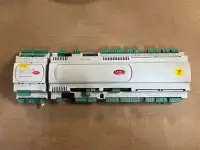
The board sizes differ in the number of inputs and outputs. A pCO2 Small fits a 13-module DIN rail space, and Carel's pCO2 code list pairs PCO2000AS0 with SMALL and PCO2000AM0 with MEDIUM. Our stock follows the same pattern: PCO1000AS0 and PCO1000AM0 are pCO1 boards, PCO2000AS0 and PCO2000BS0 are pCO2 boards, PCO3000AS0 is a pCO3. Carel offers pCO2 boards with and without a built-in terminal. Before you swap, compare the full code on the old board's label with the new one, character for character.
Why the software matters
A new pCO from Carel normally arrives blank. Distributors state it plainly: unless agreed otherwise, the controller ships without software. A used board from another machine carries that machine's program, which is very unlikely to be yours.
So a working replacement needs three things:
- The same board family and size, so every input and output the machine uses exists on the new board.
- The application program for your machine, in the version your unit runs.
- Your unit's settings: setpoints, sensor types, the pLAN address, alarm limits.
The program belongs to the machine's maker. Carel does not keep a copy of every OEM's software for you. Ask the OEM or its service partner for the application file, quoting the unit's model and serial number. Some units run one of Carel's own standard applications for chillers and other unit types; then Carel's local distributor is the place to ask.
Loading is done with Carel's pCO Manager, a free tool from Carel's KSA download area, over a PC connection, or with a programming key that copies a program from one board to another. If your old board still powers up, write down every parameter before you remove it. A key copied from the old board is the fastest route when it still works.
Terminals: pGD and the built-in display
The pCO board has no screen of its own unless it is a version with a built-in display. Most installations use a separate terminal on a telephone-style cable. The pGD family (pGD0, pGD1 and larger graphic versions) is the common one; Carel lists the pGD1 as compatible with pCO1, pCO2, pCO3, pCOXS and pCOC, with some version limits. A pCO1, pCO2 or pCOXS can power one standard terminal itself.
Terminal and boards talk over pLAN, Carel's own local network, and each device has a pLAN address. One terminal can serve several boards. If the replacement board does not show on the terminal, the address is the first thing to check.
Interface and expansion boards
Around the main board you often find smaller Carel boards. These are the ones we hold:
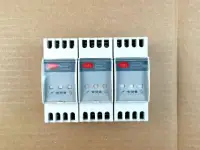
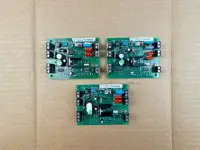
- PCOE00TLN0: the pCOe I/O expansion in its tLAN version. Carel's manuals describe a pCO1, pCO3 or pCO5 in tLAN master mode working with it, if the application is written for it.
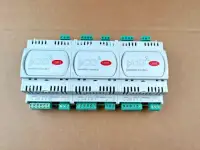
- PCOUMID000: the humidifier interface. It turns the humidifier's conductivity and water-level signals into signals the pCO inputs can read. Carel's later PCOUMID200 does the same job in a DIN-rail plastic case, and the pCO software has a parameter to say which board is fitted.
- PCOUMI2000: a module for Carel's OEM humidifiers, listed by Carel distributors with a 0 to 10 V output and an RS485 port.
- FLOE000010: Carel's flooding detector, two DIN modules, for water probes under raised floors and units. In normal state the alarm relay is energised, so a cut wire also raises the alarm.
- MCHRTF12C0: a cut-phase fan speed board from the MCHRTF series, the 12 A size. We also hold FCS-series fan speed controllers (FCS1122300), which work standalone or under a pCO.
Before you replace the board
- Photograph the board in place, both labels and every connector, before you unplug anything.
- If the terminal still works, note the program name and version it shows, and every setpoint.
- Check the board's supply and the terminal cable before you blame the board.
- Mains wiring on the unit (compressor contactors, fans, heaters) is work for a qualified electrician or the unit's service company.
We have 69 Carel pieces on the shelf in Szeged, most of them pCO2 boards (20 of PCO2000AS0, 18 of PCO2000BS0). Each quote describes the condition of the piece we would send, and photos are available on request. Send us the full code from your board's label through the price request, and we reply with the price and the FedEx cost to you.