

Read the type code first
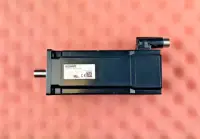
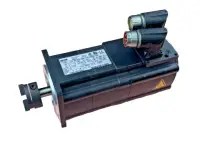
The type code tells you what the motor should be: size, winding, encoder, brake. Every test after this is a comparison against it. Take a Rexroth MSK we have on the shelf, the MSK040C-0600-NN-M1-UG1-NNNN, and read it field by field against Rexroth's MSK project planning manual:
| Field | Code | Meaning |
|---|---|---|
| Product | MSK | Rexroth IndraDyn S synchronous servo motor |
| Frame size | 040 | Size 40 |
| Frame length | C | Length C within size 40 |
| Winding | 0600 | Winding code; sets rated speed and current |
| Cooling | NN | Natural convection |
| Encoder | M1 | Optical encoder, Hiperface, multiturn absolute, 128 signal periods |
| Electrical connection | U | Power and encoder connector, rotatable |
| Shaft | G | Smooth shaft |
| Holding brake | 1 | With holding brake |
| Other design | NNNN | Standard version |
Its smaller neighbour on the shelf, the MSK030B-0900-NN-M1-UG0-NNNN, ends in UG0: same encoder type, smooth shaft, and no brake. One digit, and the brake check below does not apply.
The winding resistance, voltage constant and brake data for each code are in the motor's data sheet. Have it open while you test.
Visual check and shaft
- Connectors: bent or pushed-back pins, cracked inserts, corrosion.
- Shaft: marks from a clamping hub or coupling, a burr on the keyway, rust.
- Shaft seal: dried out or torn. On a motor that sat under coolant this matters.
- Housing: discoloured paint near the flange can mean the motor ran hot.
- Nameplate: legible, and matching the type code you were sold.
Turn the shaft slowly by hand with the motor disconnected. A permanent magnet servo has a light, even cogging. Roughness, grinding or a tight spot points to the bearings. Rock the shaft sideways and in and out; you should feel no play. If you have a dial indicator, measure it.
Winding resistance, phase to phase
With a good multimeter, or better a milliohm meter, measure U to V, V to W and W to U on the power connector. The three readings should match each other within a few percent. Small servo motors read a few ohms, larger ones a fraction of an ohm, so subtract the resistance of your test leads.
Compare with the data sheet value, which is given at 20 °C. Copper rises by about 0.4 % per kelvin, so a warm motor reads a little high. One phase clearly higher than the other two suggests a bad connection or a damaged winding; one lower, a short between turns.
Two quick checks with the shaft
Shorted phases. Connect U, V and W together and turn the shaft. It should feel heavy and evenly braked all the way round, because the magnets now drive current through the shorted winding. A notchy or uneven feel suggests a winding fault.
Back EMF. Open the phases again, spin the shaft by hand or with a drill at a steady speed, and measure AC volts between each pair of phases. The three readings should match. If you know the speed, compare with the voltage constant on the data sheet (volts per 1,000 rpm). Keep fingers off the pins: a fast spin produces real voltage.
Insulation test to housing
This is the test that finds a motor that will trip the drive with an earth fault.
- Disconnect the motor cable from the drive. An insulation tester on a motor still wired to a drive can damage the drive and gives a false reading anyway.
- Unplug the encoder.
- Tie U, V and W together.
- Test between the three phases and the housing (PE) with an insulation tester. 500 V DC is the usual test voltage for 400 V class servo motors; use the value in the motor manual where it gives one.
- Leave the brake and temperature sensor wires out of the high-voltage test unless the manual says otherwise.
A healthy motor reads high, well into the hundreds of megohms on most testers. A low or drifting reading means moisture, coolant in the motor or damaged insulation. If you are not used to working with test voltages, have an electrician do this step.
Holding brake
A servo holding brake is electrically released: no voltage, the shaft is held; 24 V DC on the brake pins, the brake opens. Apply 24 V from a bench supply. You should hear a click, and the shaft should turn freely. Remove the voltage and it should lock again. Measure the coil resistance too and compare with the data sheet.
Rexroth notes that the holding brake is not for personal protection and is not a service brake. Treat a brake on a vertical axis as part of the machine's safety design and follow the machine's risk assessment.
How to test an encoder
What you can check depends on the feedback type.
| Feedback | What it is | What you can test without the drive |
|---|---|---|
| Resolver | Three windings, no electronics | Winding resistances; sine and cosine pairs should match |
| Incremental, TTL or HTL | A and B square waves 90 degrees apart, plus an index pulse Z | Power it, turn slowly, watch A, B and Z on a scope or counter |
| Sin/cos | Analog sine and cosine, usually 1 Vpp | Power it, watch the signals on a scope |
| Hiperface (SICK) | Sin/cos plus an RS-485 data channel | Analog signals only; the position data needs the drive |
| EnDat (Heidenhain) | Bidirectional serial interface | Very little; needs an EnDat-capable reader or drive |
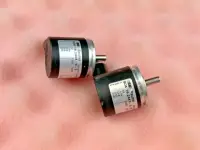
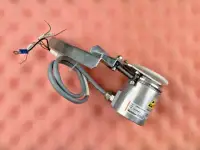
For an incremental encoder like the Baumer or Kübler units on our shelf, use the supply voltage from the data sheet (5 V for TTL, 10 to 30 V for HTL is typical), then turn the shaft slowly. A and B should toggle in turn, and Z should pulse once per revolution. On a scope, check that the edges are clean and that the differential pairs (A and /A) are mirror images.
What you cannot check without the matching drive
- The absolute position and the data channel of Hiperface or EnDat encoders.
- The commutation offset: whether the encoder still sits at the angle the drive expects. A motor that has had its encoder removed can run rough or run away.
- Motor data stored in the encoder. On Rexroth MSK motors the encoder memory holds the motor parameters, and the IndraDrive reads them at power-up.
- Behaviour under load and heat.
The final test is the motor on its own drive, with its own cables, running a move at low speed with the torque limit set low. Watch the current and the following error. If the drive reads the encoder without errors and the motor runs smoothly in both directions, you have a good motor.
Repair or replace
Bearings, shaft seals and connectors are routine work for a servo motor repair shop. A Hiperface or EnDat encoder needs its commutation offset set again after replacement, which takes the right drive or tool.
If you need a replacement, we hold Rexroth MSK motors with RKL4302 power and RKG4200 encoder cables, and servo motors from Beckhoff, Lenze, Kollmorgen and Pacific Scientific. Send us the full type code through the price request form; we describe the condition of the piece in the quote and send photos on request. For choosing between servo and stepper in the first place, see servo motor vs stepper motor.