What a VFD does
A variable frequency drive (VFD, frequency inverter, frequency converter) rectifies the mains into a DC bus, then switches that DC with IGBTs into a three-phase output of adjustable frequency and voltage. An induction motor's speed follows the frequency: a four-pole motor runs at just under 1,500 rpm on 50 Hz and at about half that on 25 Hz.
The VFD's job is speed, and sometimes torque. It does not know where the shaft is. Most VFDs run standard induction motors without any encoder.
What a servo drive does
A servo drive has the same power stage, but it runs a permanent magnet servo motor and reads the motor's encoder or resolver. Inside it run three nested loops: current (torque), speed and position. The controller, a PLC or motion controller, sends position or speed setpoints, usually over EtherCAT, SERCOS III, PROFINET or EtherNet/IP, and the drive makes the shaft follow them within a fraction of a degree.
So the short answer to "what is a servo drive" is: a drive that controls position, using feedback from the motor.
V/f, vector and servo control
| Mode | How it works | Typical use |
|---|---|---|
| V/f (volts per hertz) | Output voltage rises in proportion to frequency; no motor model | Pumps, fans, simple conveyors |
| Sensorless vector | The drive models the motor and splits current into flux and torque parts | Conveyors, mixers, hoists, anything that needs torque at low speed |
| Closed-loop vector | Vector control plus an encoder on an induction motor | Winders, cranes, accurate speed at standstill |
| Servo | Permanent magnet motor, encoder, position loop in the drive | Positioning, pick and place, synchronised axes |
On a 400 V, 50 Hz motor, V/f means 8 V per hertz: 200 V at 25 Hz. It is simple and robust, and it is what most pumps and fans run on. Vector control is the setting to try when a conveyor stalls at start or a mixer loses speed under load.
When a VFD is enough
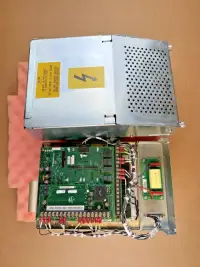
- Pumps and fans. Speed sets flow, and slowing a centrifugal fan or pump saves a lot of energy. Grundfos builds the inverter into many of its pumps; we have Grundfos 22 kW inverter and rectifier boards on the shelf.
- Conveyors. Speed matters, position does not, or a sensor at the end of the belt handles it.
- Mixers, agitators, spindles that run at a set speed.
A VFD will also do rough positioning with an encoder and a few limit switches, but once moves must be fast and repeatable you are rebuilding a servo drive by hand.
When you need a servo drive
- The axis must stop at a position, repeatably: indexing tables, cut to length, pick and place.
- Several axes move together: gantries, flying saws, electronic cams.
- Fast acceleration with a small motor.
- The machine must know its position at power-up (a servo motor with an absolute encoder).
See servo motor vs stepper motor for the motor side of this choice.
Rexroth IndraDrive: Cs, C and M
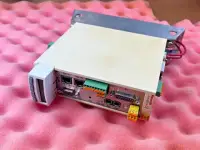
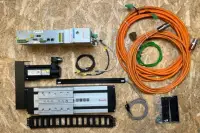
Rexroth's IndraDrive family comes in three ranges, and we hold parts from all three.
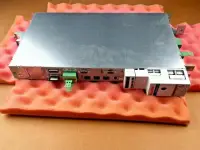
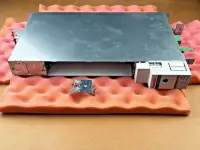
IndraDrive Cs is the compact range, built around the HCS01 converter. Rexroth's project planning manual for it lists mains connection of 3 AC 110 to 230 V or 3 AC 200 to 500 V depending on the size, maximum currents from 3.3 A to 54 A, Rexroth MSM and MSK motors as well as third-party motors, and a multi-encoder interface that reads Hiperface, EnDat 2.1, SSI, TTL, sin/cos and resolver.
The HCS01 type code carries its control section. Read one of ours, HCS01.1E-W0008-A-03-B-ET-EC-PB-S4-NN-FW:
W0008: 8 A maximum current.A-03: mains connection 3 AC 200 to 500 V.B-ET: the BASIC version with Multi-Ethernet, which covers sercos III, PROFINET IO, EtherNet/IP and EtherCAT. ECONOMY isE-S3(sercos III only); ADVANCED isA-CC.EC: the standard encoder evaluation.PB: PROFIBUS as the optional extra interface.S4: a safety technology option; check which with Rexroth before you rely on it.
IndraDrive C is the converter range with HCS02 and HCS03: one unit per axis, mains in, motor out, with a plug-in control section.
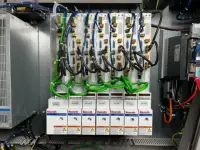
IndraDrive M is the modular range for multi-axis machines: an HMV supply unit feeds a shared DC bus, and inverters hang off it, HMS for one axis and HMD for two. The control sections plug in: CSB (BASIC) and CSH (ADVANCED) for single-axis units, CDB for the double-axis HMD.
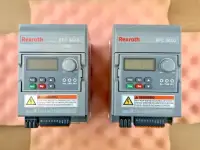
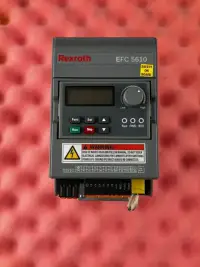
Rexroth also makes ordinary VFDs. The EFC 3610 and EFC 5610 are frequency converters for induction motors, and their type codes read plainly: 0K40 is 0.4 kW, 1P2 single-phase 200 to 240 V, 3P4 three-phase 400 V. We have an EFC3610-0K40-3P4 and an EFC5610-0K40-1P2.
Lenze and others on our shelf
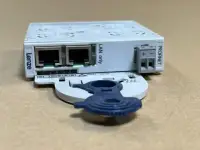
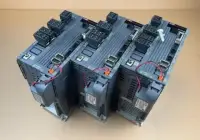
From Lenze we hold the CANopen (E94AYCCA) and PROFINET (E94AYCER) communication modules for the 9400 servo drives, and MCS servo motors. There is also a Mitsubishi MR-J4W2-77B two-axis servo amplifier, Beckhoff AX5000 servo drives, Kollmorgen Servostar amplifiers, a Pilz PMCprotego D servo amplifier, and an Allen-Bradley 1336F VFD.
Before you swap a drive
A replacement servo drive must match the motor's encoder type, the mains voltage and the fieldbus, and it needs the parameters of the one it replaces. Save the parameter file from the old drive if it still talks. With a VFD, the nameplate data of the motor and the ramp times usually get you running again.
Mains wiring on any drive is work for a qualified electrician, and the DC bus stays charged for minutes after switch-off; the drive's manual gives the wait time.
If you need a drive from this page, send the full type code via the price request form. We will tell you the condition of the piece we have and the FedEx cost from Szeged.