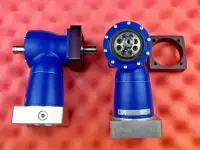


Why servo motors use a gearbox
A servo motor is happiest at a few thousand rpm. Most machine axes want a few hundred, with more torque than a small motor gives. A gearbox with ratio i divides the speed by i and multiplies the torque by i, less a few percent for losses. A 3:1 gearbox on a 3,000 rpm motor gives 1,000 rpm at the output and close to three times the torque.
The less obvious reason is inertia matching. The load's inertia, seen from the motor, is divided by the square of the ratio. A 10:1 gearbox makes a heavy rotary table look a hundred times lighter to the motor. A servo controls a load well when the load inertia, reflected to the motor shaft, is not much larger than the motor's own; many servo makers give a ratio of about 10:1 as a working limit, and less for very dynamic axes. Without a gearbox you would often need a much bigger motor just to keep that ratio, not for the torque.
Why planetary
In a planetary stage the sun gear on the input shaft drives three or more planet gears, which roll inside a ring gear and carry the output. The load is shared over several teeth, so the gearbox is short and stiff for its torque, and the input and output sit on one axis. One stage gives ratios of about 3 to 10. Two stages go to 100.
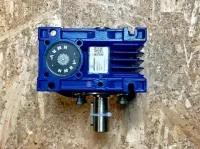
Worm gearboxes, like the Motovario NMRV 050 on our shelf, give a high ratio in one stage and a right angle, but they have more backlash and lower efficiency. They suit conveyors driven by a standard motor better than servo axes.
Backlash in arcmin
Backlash is the angle the output can turn while the input is held still. Servo gearboxes give it in arc minutes: 1 arcmin is 1/60 of a degree.
That sounds tiny. At the end of a 100 mm lever, 4 arcmin is about 0.12 mm of play, and it shows up every time the axis reverses. For a conveyor it does not matter. For a rotary indexing table, a robot joint or a rack and pinion it decides how accurate the machine can be.
Wittenstein's SP+ 060 in one stage, for example, is catalogued at 4 arcmin or less in the standard version and 2 arcmin or less with reduced backlash. Two-stage versions of the same size have a little more.
Wittenstein lines: SP+, TP+ and the economy ranges
Wittenstein alpha sorts its servo gearboxes into four lines. The figures below are the coaxial (planetary) gearboxes as listed on Wittenstein's own product pages.
| Line | Planetary series | Max. backlash |
|---|---|---|
| Premium | RP+, XP+ | 1 to 4 arcmin, by size and version |
| Advanced | SP+ (shaft output), TP+ (flange output) | 1 to 4 arcmin (SP+), 1 to 3 arcmin (TP+) |
| Value | NP, NPL, NPS, NPT, NPR, NTP | 8 arcmin (NTP 5) |
| Basic | CP | 12 arcmin |
The SP+ and TP+ are what you find on most European machine tools and packaging lines. The NP and CP ranges cost less and suit axes where a few arcmin more do not matter. Wittenstein also builds right-angle gearboxes: the SK+ is a hypoid right-angle unit, and the TK+ a right-angle unit with flange output.
Other makers on servo axes include Rexroth with its own GTE planetary gearboxes, Thomson (Micron) and Neugart.
Reading a Wittenstein type code
Take the SP 060S-MF1-3 on our shelf. Against the SP+ catalogue:
SPis the series, SP+.060is the size.MFis the version. The catalogue lists the MF version as the standard motor-mounted SP+.1is the number of stages: one.3is the ratio, 3:1.
The groups that follow on a full code describe the output shaft and the motor adapter; ours is listed without them, so read the full code from the type plate before ordering an adapter. For this gearbox in one stage at i = 3, the catalogue gives 17 Nm nominal output torque, 30 Nm maximum acceleration torque, 6,000 rpm maximum input speed and 97 % efficiency at full load. The right-angle SK+ 060B-MF1-10 we hold follows the same pattern, with its ratio, 10:1, at the end.
Matching the gearbox to the motor
A servo gearbox mounts to the motor with two parts: a clamping hub that grips the motor shaft, and an adapter plate that matches the motor flange.
- Shaft diameter. The clamping hub bore must match the motor shaft. On the SP+ 060 the catalogue lists hubs of 11, 14 and 19 mm.
- Shaft type. A smooth shaft (the G in a Rexroth MSK type code) clamps best. For a keyed shaft, follow the gearbox maker's instructions.
- Flange. The adapter plate must match the motor's centring diameter, bolt circle and shaft length.
- Speed and torque. Check the motor's maximum speed against the gearbox's maximum input speed, and the motor's peak torque times the ratio against the gearbox's acceleration and emergency stop torque.
Mount the motor as the gearbox manual describes. The hub screw has a set tightening torque, and getting it wrong lets the shaft slip.
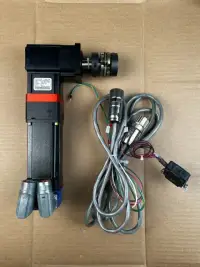
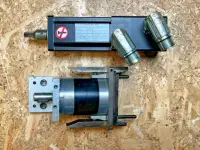
Gearboxes and motors often come off a machine as a pair. The Wittenstein MSSI on our shelf is a cyber motor with its gearbox, the Kollmorgen MT1506 Goldline motor carries a Thomson DTR060 gearhead, and the TK+ right-angle unit is still fitted to a Rexroth motor. Buying the pair saves the adapter question.
What we hold
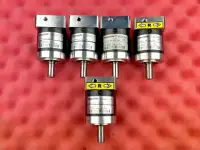
Wittenstein SP+, SK+, TK+ and an MSSI motor with gearbox, five Rexroth GTE060 planetary gearboxes, a Thomson Micron gearhead and a Jenaer planetary gearbox that goes with its motor. All are in servo drives and motors and on the Wittenstein maker page. If you need one, send us the part number and your motor's type code through the price request form, so we can quote the piece that fits.